
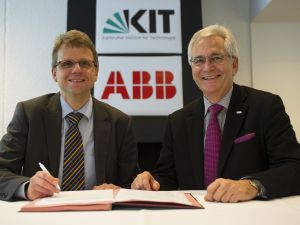
Karlsruhe Institute of Technology (KIT) and ABB signed a framework agreement to facilitate future cooperation. Apart from cooperative research and the joint execution of publicly funded research projects, ABB also plans to grant research contracts to KIT. Among others, work will focus on the lifecycle management of products and systems and application of superconductivity in electric energy technology.
In addition, KIT and ABB want to cooperate in the model-based development of embedded systems and develop scenarios for smart buildings and electric mobility. Cooperation will also cover load and consumption management in smart electricity distribution grids.
“We are very happy about this cooperation with ABB, a worldwide leading partner in power and automation technologies. Together, we will accept the technical challenges in energy technology and develop new systems required for the success of the energy turnaround,” says KIT Vice President Dr. Peter Fritz.
“KIT is an internationally renowned research institution situated in our direct vicinity,” says Dr. Peter Terwiesch, CEO of ABB AG and Regional Manager Central Europe. This framework agreement provides ABB with the opportunity to participate in excellent fundamental research, to transfer research findings to new products and solutions, and to strengthen the innovative capacity of both the region and the Federal Republic of Germany.”
About ABB
In 2011, ABB Germany reached a turnover of EUR 3.43 billion and employed about 10,000 people. ABB is a leader in power and automation technologies. The company enables utility and industry customers to improve performance while lowering environmental impact. The ABB Group employs about 145,000 people in around 100 countries.
In close partnership with society, KIT develops solutions for urgent challenges – from climate change, energy transition and sustainable use of natural resources to artificial intelligence, sovereignty and an aging population. As The University in the Helmholtz Association, KIT unites scientific excellence from insight to application-driven research under one roof – and is thus in a unique position to drive this transformation. As a University of Excellence, KIT offers its more than 10,000 employees and 22,800 students outstanding opportunities to shape a sustainable and resilient future. KIT – Science for Impact.