
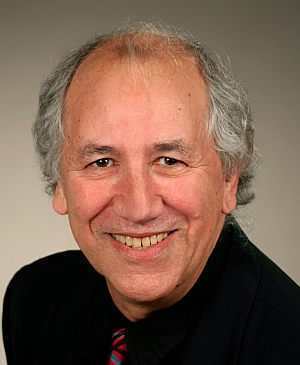
The state of Baden-Württemberg will fund a research stay of the pioneer of nanochemistry, Professor Geoffrey Ozin, at KIT. Together with scientists of the DFG Center for Functional Nanostructures (CFN), the materials scientist from Toronto is working on novel architectures of photonic crystals for innovative optical and electronic applications. Funding has the character of an honor with KIT granting to Ozin the title “KIT Distinguished Research Fellow”.
For Ozin’s research stay at KIT, the State Ministry of Science will provide a total amount of EUR 150,000 within the framework of the program “Guest Professorship/Foreign Member”. KIT will contribute the same amount. The funding program serves to support universities in strengthening international cooperation and preparing for the next round of the excellence competition. The funded scientists must be involved in an excellence project.
Over a duration of three years, Geoffrey Ozin will stay at KIT for three months each. His research project is of interdisciplinary nature and based on existing cooperation with CFN scientists, for example, with the professors Martin Wegener and Kurt Busch (physics), Annie Powell and Claus Feldmann (chemistry), and Uli Lemmer (electrical engineering). The project pursuing a nanochemical approach is aimed at studying and applying photonic crystals, i.e. materials with periodically arranged structures that specifically influence light. Based on findings of research into so-called frozen photons, the materials scientist generates new structures of photonic crystals for the development of more efficient solar cells and light sources, for instance.
Geoffrey Ozin is professor at the Department of Chemistry of the University of Toronto. For more than three decades, he has been contributing decisively to materials chemistry and nanochemistry and is among the top scientists in this field. So far, he has published more than 600 articles in high-ranking international journals with a total of more than 24 000 citations. His cooperation with industry gave rise to numerous new developments and licenses. He was granted twelve patents and applied for another 37. He also rendered outstanding services as an academic teacher. For his research work, Ozin was granted numerous awards, among others the “Alexander von Humboldt Senior Scientist Prize” in 2005, the “Royal Society of Chemistry Great Britain 2002 RSC Award in Materials Chemistry”, the title “ISI Highly Cited Researcher in Materials Science” in 2002, and lately the “Discovery Award” of the province of Ontario in the amount of 500 000 Canadian Dollars.
In close partnership with society, KIT develops solutions for urgent challenges – from climate change, energy transition and sustainable use of natural resources to artificial intelligence, sovereignty and an aging population. As The University in the Helmholtz Association, KIT unites scientific excellence from insight to application-driven research under one roof – and is thus in a unique position to drive this transformation. As a University of Excellence, KIT offers its more than 10,000 employees and 22,800 students outstanding opportunities to shape a sustainable and resilient future. KIT – Science for Impact.