
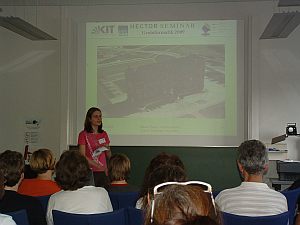
During the project phase, the Hector Seminar familiarizes talen-ted pupils from intermediate grades of secondary schools with scientific work. Among the supervisors are scientific employ-ees of Karlsruhe Institute of Technology. At the project celebra-tion on Saturday, July 03, 10.30 hrs, the pupils will present the results of their projects in the seminar rooms and lecture hall of the International Department of KIT (Schlossplatz 19, building 20.10).
Eight teams will present their projects briefly and answer the ques-tions of their classmates, parents, teachers, and scientists. The top-ics covered range from cave research to diamond chemistry to parti-cle physics. Heads of working groups and scientists provide instruc-tion over a period from six to twelve months, while the pupils rebuild the model of a Mars robot for the exploration of far-away planets or program computers on their own. Other projects focus on graph theory or the production of Hector coke, on how medical substances are extracted from plants, or on sphere theory.
The Hector Seminar is a project to support highly talented pupils in the fields of mathematics, computer science, natural science, and engineering. It is organized at Heidelberg, Karlsruhe, and Mann-heim. Since 2000, the seminar has been run by the Hector Founda-tion in cooperation with the Oberschulamt Karlsruhe (Supervisory School Authority). The Foundation is named after its founder Hans-Werner Hector.
From 9.30 hrs, the Head of the Hector Seminar, Dr. Jan Erichsen, and the working group heads of the projects will be available for a press conference (for registration, please contact the person under “further information” on page 1). Detailed information on the Hector Seminar and the projects will be given in the press kit.
In close partnership with society, KIT develops solutions for urgent challenges – from climate change, energy transition and sustainable use of natural resources to artificial intelligence, sovereignty and an aging population. As The University in the Helmholtz Association, KIT unites scientific excellence from insight to application-driven research under one roof – and is thus in a unique position to drive this transformation. As a University of Excellence, KIT offers its more than 10,000 employees and 22,800 students outstanding opportunities to shape a sustainable and resilient future. KIT – Science for Impact.