
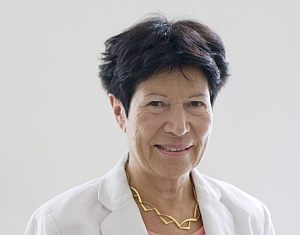
How does science change with a changing society? Professor Helga Nowotny, President of the European Research Council, will deal with this question on Tuesday, May 18, 2010, 18.00 hrs, within the framework of the Jean Monnet Keynote Lecture. The event will be organized by ZAK I Center for Applied Cultural Science and Studium Generale at KIT, in cooperation with the Karlsruhe University Society and the Heinrich Hertz Society. Admission to the lecture (NTI-Hörsaal, KIT Campus South, building 30.10, Engesserstraße 5) is free.
Using the examples of Charles Darwin and Craig Venter, Nowotny will demonstrate the co-evolution of science and society and their mutual influence. With a changing society, types of organizations, funding models of science, its epistemic fundamentals, and its appearance are changing as well. According to Nowotny, the equivalent of a knowledge-based innovation society is the “democratization of science”. Do these approaches agree with reality?
Nowotny deals with this question by using the researchers Charles Darwin and Craig Venter as examples. Darwin’s theory of evolution sustainably influenced both society and numerous scientific disciplines. Craig Venter, biochemist and genetic researcher from the USA, succeeded in sequencing the human genome in a private research project. This also had enormous impacts on science and society.
From 1987 to 1996, the Austrian sociologist and science researcher Prof. Dr. Helga Nowotny was professor and member of the board of the Institute for Science Theory and Science Research of the University of Vienna. Then, she held a professorship for science research at ETH Zurich until 2002. Her work focused among others on research policy. From 2001 to 2006, she chaired the European Research Advisory Board (EURAB) and from 2007 to February 2010, she was Vice President of the European Research Council (ERC). In February 2010, she was elected President of the ERC and Chairwoman of the Scientific ERC Advisory Council.
The Jean Monnet Keynote Lecture focuses on “European Integration and Identity”. It is presented once per semester and part of the EU-funded Jean Monnet teaching module of ZAK. This summer semester, the keynote lecture is linked with the Colloquium Fundamentale that addresses public science as a “Challenge for University and Society”. “Science and Society” is presented as a European task.
In close partnership with society, KIT develops solutions for urgent challenges – from climate change, energy transition and sustainable use of natural resources to artificial intelligence, sovereignty and an aging population. As The University in the Helmholtz Association, KIT unites scientific excellence from insight to application-driven research under one roof – and is thus in a unique position to drive this transformation. As a University of Excellence, KIT offers its more than 10,000 employees and 22,800 students outstanding opportunities to shape a sustainable and resilient future. KIT – Science for Impact.