
Decades-Old Assumption About Nickel Catalyst Disproven
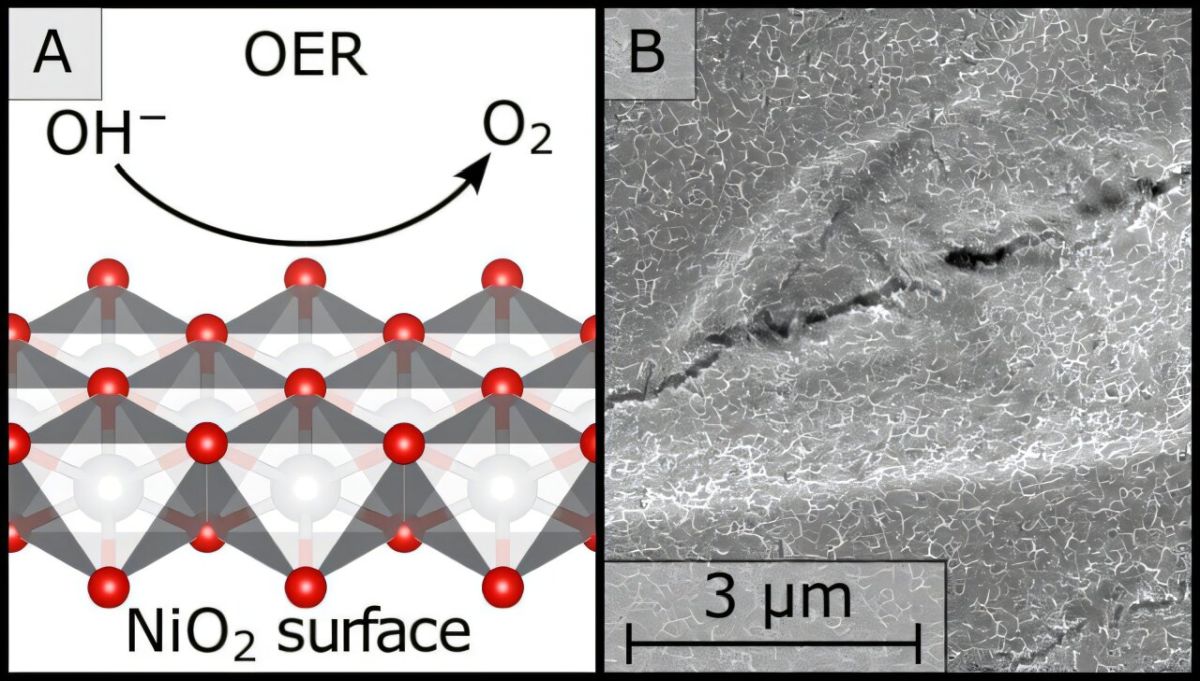
Green hydrogen is considered a possible building block for a climate-neutral energy system. It is produced through electrolysis, in which water is split into hydrogen and oxygen using electricity from renewable energy sources. For the simultaneously occurring and process-limiting oxygen evolution reaction (OER), nickel electrodes are used in electrolyzers, among other technologies. Under reaction conditions, an oxidized layer forms on their surface and acts as a catalyst. A research team from Karlsruhe Institute of Technology (KIT) and Ulm University has now shown that this active surface consists of a different material than previously assumed. The study was published in Nature Catalysis.
New Structure Changes Understanding of the Reaction
“This difference is fundamental from a chemical perspective: Until now, it had been assumed that nickel oxyhydroxide forms on the electrodes, and this compound contains hydrogen atoms. In contrast, the nickel dioxide we identified contains no hydrogen. As a result, the previously assumed adsorption sites and reaction pathways on the surface must be reassessed,” says Professor Timo Jacob of the Helmholtz Institute Ulm (HIU), a joint institution of KIT and Ulm University.
The new finding could also have implications for the design of electrolyzers: “Only when the structure of a material has been clearly determined is it possible to understand the reactions occurring at the electrode, which in turn enables the development of new materials,” says Albert Engstfeld, who co-coordinated the work at the Institute of Electrochemistry at Ulm University.
sbo/mhe, November 12, 2026