
Intense laser light pulses increase the brightness of high cirrus clouds. Together with colleagues from Berlin and Geneva, climate researchers from Karlsruhe Institute of Technology (KIT) have been investigating the interactions of laser light and ice clouds using the unique AIDA aerosol and cloud chamber on KIT’s Campus North. The results of these studies have been published in the renowned Proceedings of the National Academy of Sciences of the United States of America (PNAS).
Can cloud formation, precipitation or thunderstorms be influenced by laser light irradiation? This issue has been investigated by researchers from KIT’s Institute for Meteorology and Climate Research – Atmospheric Aerosol Research (IMK-AAF), Freie Universität Berlin, and the University of Geneva. The objective of the studies conducted by head of IMK-AAF Professor Thomas Leisner was to find out whether and in how far laser light and plasma can influence cloud formation.
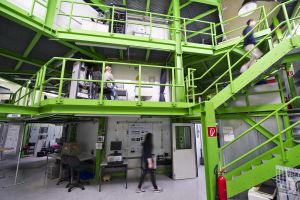
For their investigations, the researchers used the facility AIDA (Aerosol Interactions and Dynamics in the Atmosphere) on KIT’s Campus North and the mobile laser lab “Teramobile” developed in Geneva and Berlin. AIDA offers unique possibilities of studying aerosol and cloud processes under atmospheric conditions and can simulate all temperature and pressure conditions occurring in the lower and middle atmosphere.
The “Teramobile” generates high-intensity laser light pulses. Unlike normal laser light, these pulses propagate in a specific way in the atmosphere. “Due to nonlinear optical effects, these laser pulses kind of produce their own light guides, thus remaining sharply focused over long distances even if they would normally be dissipated by airborne particles and atmospheric opacity,” explains Professor Thomas Leisner. A current-conducting plasma channel forms as the air gets ionized along the laser beam.
Effects of plasma channels on ice formation or precipitation processes could not be proved in typical storm clouds, where ice crystals and subcooled water droplets coexist. In high cirrus clouds, which consist purely of ice crystals, the researchers, however, came across a surprisingly strong reaction to laser irradiation: As described in PNAS, the laser pulses increase the number of ice particles by up to a factor of 100 within only a few seconds. The fact that, in that way, the optical density of the cirrostratus clouds is intensified by up to three orders of magnitude makes the clouds look much brighter. “The effect exerted on a typical thin sheet of cirrostratus clouds can be imagined to resemble laser-written contrails,” Leisner says.
According to Professor Leisner, however, this laser effect on the atmosphere presently can only be applied in scientific cloud research. “Until clouds can be manipulated from the ground,” the KIT climate researcher explains “much progress is required in laser technology.”
Thomas Leisner, Denis Duft, Ottmar Möhler, Harald Saathoff, Martin Schnaiter, Stefano Henin, Kamil Stelmaszczyk, Massimo Petrarca, Raphaëlle Delagrange, Zuoqiang Hao, Johannes Lüder, Yannick Petit, Philipp Rohwetter, Jérôme Kasparian, Jean-Pierre Wolf, and Ludger Wöste: Laser-induced plasma-cloud interaction and ice multiplication under cirrus cloud conditions. In: PNAS, http://www.pnas.org/cgi/doi/10.1073/pnas.1222190110
The KIT Climate and Environment Center develops strategies and technologies to secure the natural bases of life. For this purpose, 660 employees of 32 institutes produce fundamental and application-oriented knowledge relating to climate and environmental change. It is not only aimed at eliminating the causes of environmental problems, but increasingly at adapting to changed conditions.
In close partnership with society, KIT develops solutions for urgent challenges – from climate change, energy transition and sustainable use of natural resources to artificial intelligence, sovereignty and an aging population. As The University in the Helmholtz Association, KIT unites scientific excellence from insight to application-driven research under one roof – and is thus in a unique position to drive this transformation. As a University of Excellence, KIT offers its more than 10,000 employees and 22,800 students outstanding opportunities to shape a sustainable and resilient future. KIT – Science for Impact.