
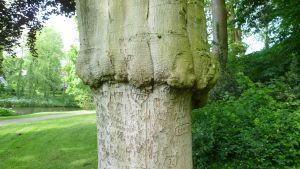
Grafted trees can be found in many public areas, for example, in parks or near roads. In some cases, the grafts hardly grow together again. They may cause unforeseeable brittle fracture and, hence, considerable damage. At Karlsruhe Institute of Technology, two complementary methods have been developed to assess the safety of grafted trees.
Trees in publicly accessible areas have to be safe. Under certain circumstances, it is possible to claim damages in case of tree accidents. To assess the risk potential of trees, Professor Dr. Claus Mattheck and his team from the Biomechanics Division of Karlsruhe Institute of Technology (KIT) developed the Visual Tree Assessment (VTA) method in the 1990s already. Today, this method is widely used, also as a basis of court decisions not only in Germany. Since then, complementary study methods have been developed and transferred to practice.
Now, grafted trees are in the focus. Grafting is the artificial connection of a leaf-bearing scion with a rooted base, a type of transplantation of the tree species desired onto a foreign root system. Tree nurseries make graftings in order to generate genetically identical scions with known properties. In this way, tree species are adapted to certain locations or provided with disease-resistant root systems.
“In our latest studies, we found that brittle fracture occasionally occurs at grafts that have grown together badly,” explains Claus Mattheck. “This failure cannot be predicted from the outer appearance of the tree. Safe grafting cannot always be distinguished visually from a dangerous graft.”
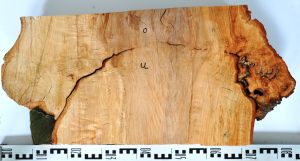
In the dried longitudinal cut of a grafted copper beech,
drying cracks along the growth seam indicate the risk. (Photo: KIT)
The risk lies in non-axial wood fibers that are transverse to force flow in the trunk. Along these wood fibers, a tree may suddenly break in transverse direction without any early warning.
At KIT, two complementary methods have been developed, by means of which tree nurseries can perform random self-control and take a sample by an invasive punching method for in-depth safety assessment:
1. When felling a grafted tree, cutting it in longitudinal direction, and drying the saw cuts, the numbers and gaps of drying cracks along the growth seam indicate the risk. In this way, tree nurseries can randomly control the quality of their graftings.
2. When punching into the weld seam of a standing tree using a hollow punch, the core and the hole reveal bark inclusions that are risk indicators.
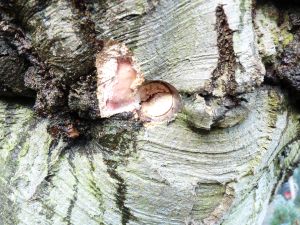
In the trunk punched in the area of a weld seam produced by grafting,
The crack enclosed by the bark can be identified – a clear risk indicator.
(Photo: Sachverständigenbüro Braukmann)
“A wedge at the end of the punch core also indicates curling up of the wood fiber, i.e. transverse tension vertical to fiber direction. We all know this risk from wood chopping,” adds Mattheck.
These new methods were presented at two large tree diagnosis conferences in England and Germany and met with high interest.
In close partnership with society, KIT develops solutions for urgent challenges – from climate change, energy transition and sustainable use of natural resources to artificial intelligence, sovereignty and an aging population. As The University in the Helmholtz Association, KIT unites scientific excellence from insight to application-driven research under one roof – and is thus in a unique position to drive this transformation. As a University of Excellence, KIT offers its more than 10,000 employees and 22,800 students outstanding opportunities to shape a sustainable and resilient future. KIT – Science for Impact.